Researchers from nine countries start Horizon Europe partnerships in Vilnius
- Home page
- Researchers from nine countries start Horizon Europe partnerships in Vilnius
A Blended Intensive Programme born in the HEROES Regional Development pod brought researchers and project managers together around three topics for the 2027 calls. The teams are now open to new partners.
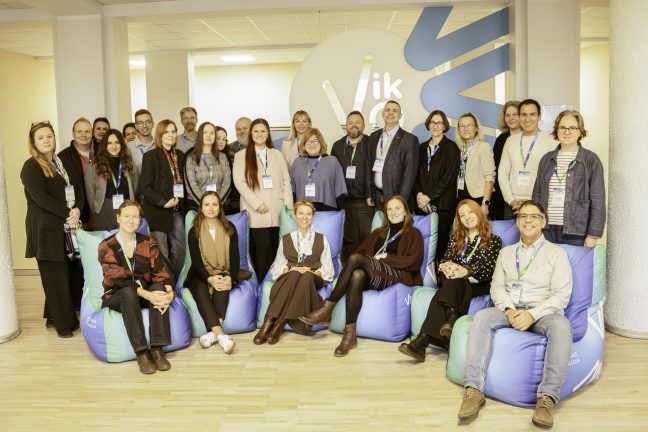
From 19 to 23 October 2026, 30 researchers and project managers from nine institutions in nine countries worked together at Vilniaus kolegija in the Blended Intensive Programme “From Ideas to Impact: Building Horizon Europe Proposals Together”. They left Vilnius with three proposal concepts for the 2027 Horizon Europe calls, and with teams that are now looking for more partners.
The participants represented Constantine the Philosopher University in Nitra, Fontys University of Applied Sciences, Mendel University in Brno, the Polytechnic Institute of Beja, Seinäjoki University of Applied Sciences, the University of Rijeka, Deggendorf Institute of Technology, the University of Primorska and Vilniaus kolegija.
The programme was coordinated by Alina Katunian, Head of the Research and Art Department at Vilniaus kolegija, and facilitated by Jiří Schneider, Head of the Department of Environmental Science and Natural Resources at Mendel University in Brno. We asked them how the idea came about, what worked and what comes next.
Proposals do not start from zero
The idea came from the HEROES Regional Development pod, which brings together colleagues from very different fields, from agriculture and business to IT and social sciences. This diversity is a strength, but it also makes it hard to turn conversations into concrete joint projects. The pod needed a space where researchers could meet around a specific topic and work on it together.
The answer was a format many know from student mobility. Vilniaus kolegija organised and hosted the programme, while Mendel University in Brno brought its expertise in Horizon Europe proposal development.
“Joint proposals don’t come from zero, especially when researchers don’t know each other yet,” says Alina Katunian. “This programme gave people a place to meet, share their knowledge and start working together.”
From idea to concept in five days
After an online session in May, participants worked in international groups on three Horizon Europe topics:
- Future-proofing sustainable cultural tourism
- Culture, heritage and creative industries for health and well-being
- Increasing the resilience of agriculture in water- and nutrient-scarce environments through digital innovations
One choice proved especially valuable in the BIP setting: every group included both researchers and project managers, working side by side while the concepts were still taking shape. “Our points of view were different, but together we could achieve much more,” says Alina Katunian. “Researchers bring the content and the ideas, and sometimes those ideas grow beyond what the call asks for. The project managers’ experience brings us back to the call. It gave me a lot to think about, especially how we can share the work when preparing our next proposals.”
On the final day, the groups presented their concepts to Monika Hamanová, an expert who evaluates Horizon Europe proposals for the European Commission. Her feedback showed the teams how their ideas would look through an evaluator’s eyes.
As facilitator, Jiří Schneider sees the clear focus as the programme’s main success. “Everything was concrete: a specific topic, clear rules and deadlines. Everyone knew exactly what we were working towards.”
What makes it work
Asked about the challenges, both Alina and Jiří pointed to the weeks before the programme rather than the programme itself. “The challenge was to bring the right people together, the most suitable researchers and project managers,” says Alina Katunian. “Some colleagues were interested but had conferences that week. Others asked why we chose these calls and not different ones.”
For Jiří Schneider, it all comes down to people. “What works best is personal contact, enthusiastic people inviting others directly.” He also has a recommendation for future programmes: decide early who the BIP is for. The format works both for experienced researchers and project managers and for newcomers who want to enter Horizon Europe, but the way participants work with each other and with the experts would be different.
For Alina Katunian, the format has uses beyond proposal writing. “A BIP like this can also help researchers work together on a specific topic, even without a particular call in mind.”
Open to new partners
Both see the programme as a beginning. Jiří Schneider recommends continuing with the next stage of proposal preparation, and he hopes the connections made in Vilnius will last beyond these three calls, whether in future proposals or joint articles.
The concepts are not final, and that is intentional. “At this stage, a concept should be inspiring enough to attract the partners who will help shape it,” says Jiří.
The teams welcome universities, research institutions, businesses and regional organisations working on these topics. To express your interest, please contact the team by 18 December 2026:
- Sustainable cultural tourism: a.katunian@viko.lt
- Culture and heritage for health and well-being: jiri.schneider@mendelu.cz
- Resilience of agriculture in water-scarce environments: m.ignatonis@viko.lt