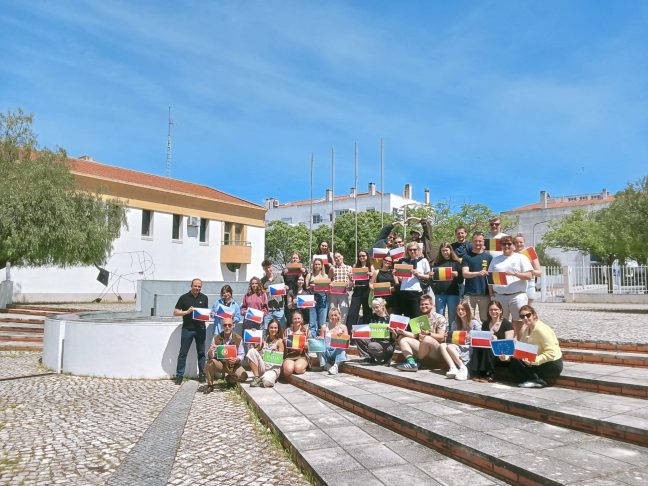
In April, I had the opportunity to facilitate the Challenge-Based Learning part of the Blended Intensive Programme (BIP) New Challenges in Livestock Production under Mediterranean Climate Conditions at our partner institution, IP Beja, in the Portuguese region of Alentejo. This part of the programme was the most valuable for me because it showed what happens when students are faced not with a classroom assignment, but with a real problem that an entire region is dealing with today.
Alentejo is one of the areas where climate change has very tangible impacts: higher temperatures, longer periods of drought, increasing pressure on water resources, worsening conditions for forage production, and a growing risk of heat stress in animals. In such a situation, it is no longer enough to teach agriculture or livestock production as a set of isolated topics. It is necessary to teach students to think in context, make decisions between alternatives, and defend solutions that are biologically, environmentally, and economically realistic.
That was exactly the aim of our CBL assignment. Students were not given a traditional task such as “repeat the theory” or “prepare a report.” Instead, they were asked to design what a cattle farm in Alentejo might look like in 2050 — a farm that would be resilient to climate conditions, remain productive, and at the same time be economically viable. It was not an exercise with one correct answer. It was about working with uncertainty, limitations, and conflicts between different goals.
This was preceded by three expert lectures (two online and one held on Monday in Beja) and visits to three very different cattle production systems in the region: extensive cattle farming in the Montado system, an intensive dairy farm, and an intensive bull fattening operation. Students therefore worked not only with theory, but also with what they actually saw in the field: different production systems, varying demands for water and feed, animal welfare in hot environments, and different levels of technology use.
For me as a facilitator, the important part was not to provide students with ready-made solutions, but to guide them in connecting knowledge from different areas — from climate and soil to nutrition, welfare, economics, and precision livestock farming (PLF). This was also where it became clear how challenging it is to try something new. Many students were used to looking for “the right answer” or proposing ideal solutions without considering regional conditions. In our case, however, it was necessary to constantly bring the discussion back to the reality of Alentejo: water scarcity, available resources, landscape characteristics, and local farming practices.
This was perhaps the most important moment of the entire process. Challenge-Based Learning does not lead students to repeat what they heard in a lecture, but to realize that every decision has consequences and that a good solution must work in a specific environment. Students learned to argue, negotiate within a team, make compromises, and justify why one path might be more realistic than another. This is exactly the kind of learning that textbooks alone cannot provide.
The result was not only student presentations, but above all the process through which students experienced what solving a real problem looks like in cooperation with regional partners. During the final discussions, it became clear that some of the proposals were surprising for local experts, sometimes even bold, but that was precisely what made them inspiring. They brought a new perspective on what a more climate-resilient and at the same time productively meaningful cattle farming system could look like in the future.
For me personally, this experience was valuable in a broader context as well. Before becoming involved in similar international formats, I viewed teaching mainly through the lens of content and expert knowledge. Thanks to my experience with HEROES and working in an international team, I now see much more strongly that it is equally important to teach students how to transfer knowledge into practice, collaborate across disciplines, and understand that resilience is not just a single technical measure, but a way of thinking. What we tested in Portugal has direct relevance for our own environment: different climate conditions, but a similar need to prepare students for a world where simple solutions are no longer enough.
This is where I see the greatest value of Challenge-Based Learning. It teaches small, concrete steps that can lead to major change. It teaches resilience not as an abstract concept, but as the ability to work with real limitations. At the same time, it confirms that what we learn in one European region can be meaningfully transferred elsewhere.