VIKO and IPBeja Put the HEROES Spiral Into Practice
- Home page
- VIKO and IPBeja Put the HEROES Spiral Into Practice
A four-day visit to Portugal brought VIKO and IPBeja colleagues together for a workshop that became a live run-through of the HEROES Spiral — participants left with a plan, not just notes.
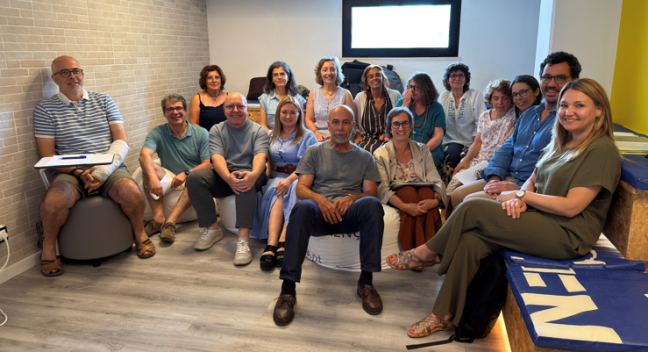
On 22–25 June 2026, two colleagues from Vilniaus kolegija (VIKO) — Andrejus Račkovskis, Head of the Centre for Teaching Excellence, and Joana Lapkovskaja, Head of the Public and Community Services Department — visited HEROES partner Instituto Politécnico de Beja (IPBeja) in Portugal to lead a hands-on Challenge-Based Learning (CBL) workshop. Twelve IPBeja lecturers and staff from a range of study fields took part.
Where experience becomes learning
The workshop rested on a simple idea: teaching methods stick when you experience them, not when someone explains them. So the session itself became a compressed version of the HEROES Spiral — the Alliance’s shared, step-by-step model for designing a challenge-based course, from framing a real problem to planning how students will tackle it.
Participants set the tone, diagnosed one of their own courses, shaped a real challenge, planned a learning cycle, and pitched it, then stepped back to reflect on what they had done as course designers. Theory took a few minutes; the rest was doing.
Tools to reuse right away
To make the method portable, the session used tools built around the HEROES Joint Guideline for CBL: a diagnostic checklist, a challenge-formulation template, and a Spiral canvas. Working through them, each participant left with a partly built plan for their own teaching — able to tell genuine CBL from activities that only resemble it, to write a challenge that is concrete, open-ended and actionable, and to sketch a full cycle with a visible output and a simple way to assess it.
Why the two partners
The pairing was deliberate. IPBeja was not starting from scratch: it has already been running challenge-based Blended Intensive Programmes with Alliance colleagues, and the workshop connected that work to a method now shared across HEROES. Within the Alliance, the Spiral is becoming the common thread that links how different universities teach through real challenges.
What comes next
IPBeja now plans to extend the method across more of its study programmes, with participants already able to shape their own challenges using the shared templates. The visit also opened conversations on community engagement and future joint activities between the two institutions.
Exchanges like this one are how a shared framework becomes everyday classroom practice across the Alliance.
HEROES is a European University Alliance of nine universities of applied sciences from nine countries. Funded by the European Union, HEROES focuses on Smart Regional Resilience — empowering regions through education, research, and innovation. Learn more: heroesuniversity.eu