Teachers Tried Out Challenge-Based Learning
- Home page
- Teachers Tried Out Challenge-Based Learning
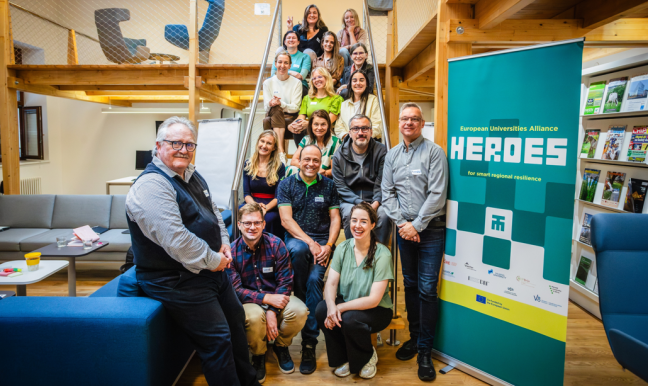
A two-day workshop within the HEROES alliance gave MENDELU teachers hands-on experience with Challenge-Based Learning, a method that puts students face to face with real-world problems instead of textbook cases.
At a workshop organized as part of the European university alliance HEROES, teachers gained hands-on experience with the Challenge-Based Learning (CBL) method, which engages students in solving real-world problems and bridges the gap between theory and practice. The goal was to introduce the method’s principles and show concrete ways it can be applied in higher education.
Where the method comes from
“The essence of Challenge-Based Learning is that students are not merely passive recipients of knowledge, but actively seek solutions to specific real-world problems,” – explained workshop instructor Milou Kauffman from Fontys University of Applied Sciences in the Netherlands, who leads Work Package WP4 (CBL) in the HEROES alliance. The approach traces back to 2008, when Apple began developing it as part of the Apple Classrooms of Tomorrow-Today project.
Theory meets teamwork
The two-day workshop combined theory with practical demonstrations and teamwork. Participants tried out the individual phases of CBL for themselves and discussed how to integrate the method into their existing courses, summer schools, online teaching, and project assignments.
“Sharing experiences with Challenge-Based Learning among the HEROES partner universities allows us to inspire one another and draw on examples of best practice,” – said Daniel Falta, associate dean of the Faculty of Agronomy and coordinator of Work Package 4 for MENDELU. He added that the method also opens the doors to closer collaboration between students and faculty from partner universities on challenges that cross disciplinary and national borders.
Already tested by students
MENDELU students have already piloted CBL in practice, working in international teams with peers from partner institution Thomas More University of Applied Sciences in Belgium on a real-world assignment. “Feedback showed that students particularly appreciated working on a specific project, the intensive use of English, and collaboration with international peers,” – said Prof. Ing. Lubor Lacina, Ph.D., from the Faculty of Business and Economics at MENDELU, who led the pilot. Some students said the format gave them more than traditional instruction and asked for more such projects, while the pilot also flagged what needs improving, mainly organization, project assignments, and communication between teams.
Students gained further hands-on experience during the international BIP programme at partner institution IPBeja in Portugal, where they designed a cattle farm adapted to the dry, hot conditions of the Alentejo region, with a vision extending to 2050.
What comes next
The pilot and the workshop will be followed by further activities to build teachers’ pedagogical skills at MENDELU. The university plans to keep developing and sharing what it learns through the international HEROES alliance network.