Dare to Taste! How Thomas More Researchers Are Shaping the Future of Food
- Home page
- Dare to Taste! How Thomas More Researchers Are Shaping the Future of Food
What will you be eating ten years from now? A sandwich, yesterday’s leftovers or something quick from the freezer? There’s a good chance your plate will feature something that sounds surprising today: a burger made from mealworms, a cricket protein bar or a liquid breakfast that tastes like fresh bread. Fantasy or utopia? Not really.
At Thomas More University of Applied Sciences, researchers and students are already exploring these possibilities, showing how applied research can make food more sustainable, inclusive and appealing.
“If I had known this earlier, it would have changed my life.”
This powerful response from a cancer patient captures the real-world impact of research at Thomas More. But the university’s work goes beyond improving nutrition in healthcare. At its Innovation Campus in Geel, Belgium, researchers are also exploring how to transform underutilized biological resources into valuable ingredients and develop more sustainable approaches to food production.
Two researchers are at the heart of this work: Lieven De Maesschalck from Mobilab & Care and Sabine Van Miert from Sustainable Biomass and Chemistry. Although they approach food from different perspectives, their research shares a common goal: finding practical solutions to real-world challenges.
The need
Lieven De Maesschalck’s research began around 25 years ago, when a nursing home approached his team with a challenge. People with swallowing difficulties needed meals that were safe to consume, nutritious and appealing. At the same time, care facilities needed solutions that could be prepared consistently, even with limited staff.
Developing suitable meals proved more complex than expected. Food needed the right texture to be swallowed safely while still tasting good. Consistency was essential, too, making traditional cooking methods difficult to standardize.
Through research, clinical validation and testing in nursing homes, the team developed new approaches, including the use of microwave technology. The results have since reached consumers, with an adapted breakfast product available in six flavors.
For Lieven, the motivation is clear: research matters when it improves people’s lives. He recalls patients who regained weight lost during hospital stays thanks to the team’s work. Their experiences demonstrate why nutrition research must consider not only nutritional value and safety, but also taste, dignity and quality of life.
The source
While Lieven focuses on people’s nutritional needs, Sabine Van Miert looks at the resources available to produce food more sustainably.
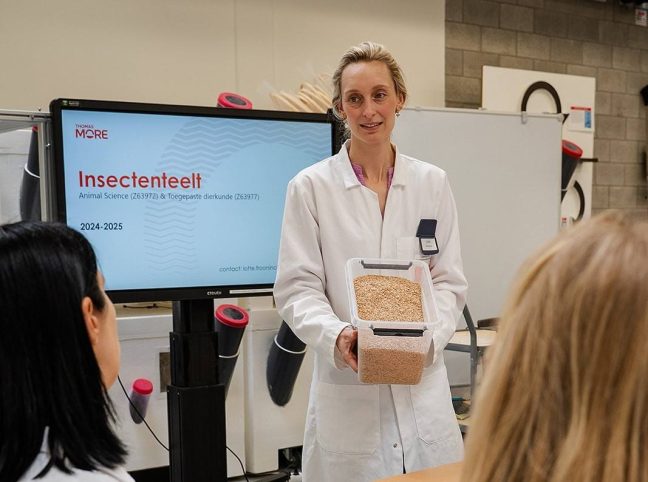
“For us, the focus is on waste. Although I’m not really allowed to use that word. It’s about underutilized residual streams,” she explains. Her research explores how insects and microalgae can grow on these residual streams and convert them into valuable components, including proteins, fats and oils. These ingredients can be used in food, animal feed and other technical applications.
The approach offers an opportunity to make better use of available resources while exploring alternative sources of protein. However, developing a promising ingredient is only part of the challenge. People also need to be willing to use it. In Western food culture, insects can still provoke resistance. Consumers may be more comfortable with insect protein incorporated into a powder or processed product than with seeing a whole insect on their plate.
This is where food innovation meets human behavior. Sustainable alternatives must be practical and appealing, not simply technically possible. Exploring different applications can also help overcome barriers. Insects, for example, may have a role in animal feed, allowing conventional protein sources to be used more strategically across food and agricultural systems.
“That’s gross!”
Fifteen years ago, a cricket protein bar might have sounded like science fiction. Today, it can be found in supermarkets.
“That bar itself has gone through an evolution, too,” Sabine says. “In the beginning, it was just a bar. Now it’s a tasty bar.” That is the key. Western consumers may be reluctant to eat insects when they can see their legs, but grinding them into a powder and incorporating them into a product can make the idea more acceptable.
Perception matters in healthcare, too. Lieven sees similar reactions when people encounter specially developed meals for patients with swallowing difficulties.
“The difference between a caregiver and a patient is huge. The caregiver says: that doesn’t look appetizing. Until they’ve tasted it. Then comes the amazement.”
His advice, both in the laboratory and at the bedside, is simple: “Taste it yourself, what you’re giving to people.”
Lieven experienced the importance of taste firsthand during a webinar with chef Jeroen Meus. Meus told him: “If only I’d known this when my brother was in the hospital. I just threw something in the blender, and it wasn’t tasty. This is.”
For Lieven, this captures the purpose of applied research: “We’re not commercially driven. We’re impact-driven. You do it for that one end user.”
The campus as a playground for innovation
Both researchers’ stories converge at the Innovation Campus in Geel, where the future of food is a key focus.
Sabine’s team, together with KU Leuven, has received approval for the Insect Practice Center, where farmers, researchers and companies can learn about insect breeding and explore how to scale up insect farming.
Another initiative is the NutriWave Hub, a €2.5 million pilot facility that Lieven is helping to develop. “A mini-factory where we do all our testing and where students can take part,” he explains.
For both researchers, student involvement is not an add-on; it is central to their work. “Students aren’t helpers doing something for free,” Lieven states firmly. “They need to be able to do something meaningful, something that helps their careers.”
His projects involve students from a wide range of disciplines, including nutrition and dietetics, chemistry, speech therapy, nursing and biomedical laboratory technology. One student might develop a recipe for a specific target group, while another investigates how honey can extend shelf life.
An important lesson students learn is the value of failure. “My first research project didn’t go as hoped either. I thought I’ve failed. But no, that gives you insight into a path you can close off. Research always yields new knowledge,” Lieven explains.
It is a lesson that reflects Thomas More’s commitment to lifelong learning: unexpected results can be valuable steppingstones towards better solutions.
Sabine shares this approach. Students become part of ongoing research projects without knowing exactly where they will lead or whether every experiment will succeed. For many, that uncertainty is part of the attraction, they are contributing to something that could become a meaningful innovation.
Her team also involves nutrition and dietetics students in competitions. Last academic year, students developed cookies using brewer’s spent grain, another underutilized residual stream.
“Then they get recognition, and we get visibility. It works both ways,” Sabine says.
The impact extends beyond the campus. In collaboration with teacher training programmes, her team develops educational materials on sustainability, insects and algae for use in classrooms. This helps teachers introduce these topics to younger generations and encourages wider conversations about the future of food.
For Lieven, student involvement also has a broader purpose. With the food industry being the largest sector in Flanders, students can become ambassadors for new knowledge and innovation, helping research make a difference beyond the university.
So, what will we eat in 2035?
Will meat disappear from our plates? Sabine thinks not. Instead, we may eat less conventional meat while having more alternatives available, from plant-based proteins to products combining meat with ingredients such as mealworm or chickpea. This is not a utopian vision, but a future with a wider range of ingredients, more options and new ways to meet nutritional needs.
For both researchers, choice is essential. “It shouldn’t be imposed,” Sabine stresses. “The moment you make something mandatory, people check out. It has to come from free curiosity.”
Lieven agrees: “Know what you eat. And stay open. Dare to taste.” His curiosity, the instinct to keep asking why this, why that? – continues to drive his work.
So, back to our opening question: what will you be eating ten years from now? A cricket protein bar, a mealworm burger or a liquid breakfast? Perhaps an innovative food product developed with the help of a Thomas More student.
Whatever the future brings, the researchers’ message is simple: stay curious, understand what you eat and dare to taste. The next food innovation might be more familiar, more useful or more delicious than you expect. And who know – maybe it will be a Thomas More student who helps bring it to your plate?
—
This article is based on a Thomas More University of Applied Sciences newsletter feature on nutrition and food innovation.